BUYER GUIDE
Tile leveling clips MOQ: how the minimum order is set
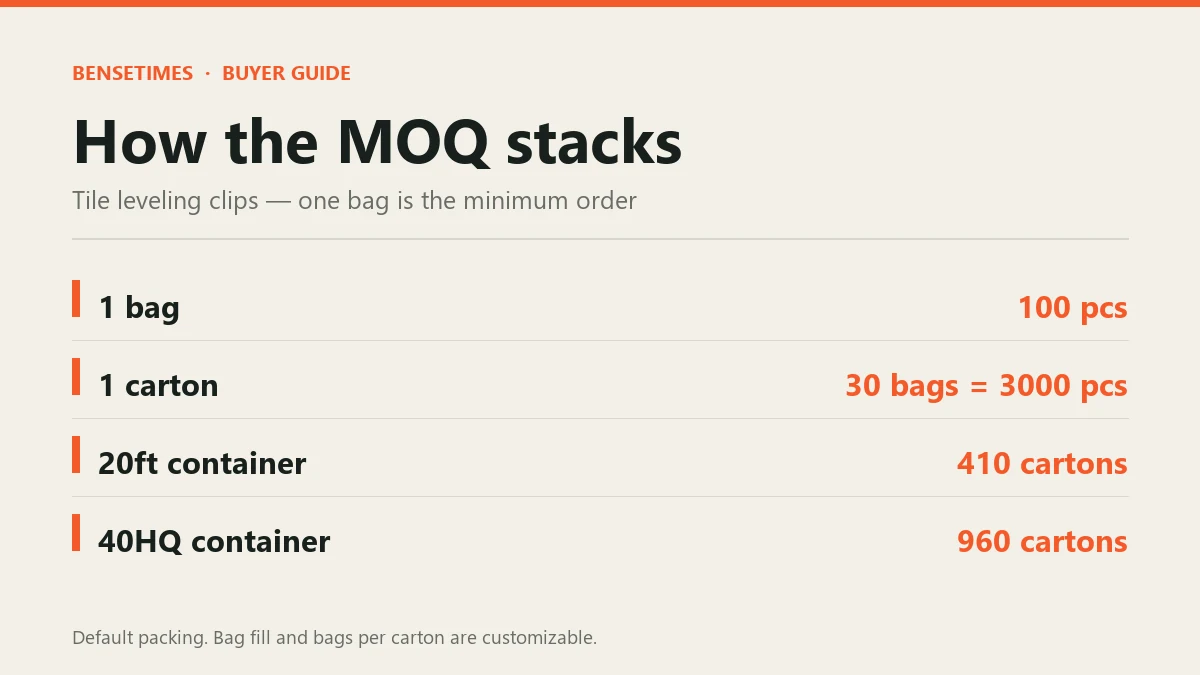
A tile leveling clips MOQ is one bag, and that bag holds 100 pcs. That is the smallest quantity we quote, because below one bag the weighing, bagging and labelling cost more than the clips inside it. Everything above that is arithmetic: how many bags go into a carton, and how many cartons go into the container you book.
What the minimum actually is
The minimum order quantity is one bag of 100 pcs. It applies per SKU rather than per order, so a buyer testing three joint widths can order three bags instead of three cartons. Bag fill and bags per carton are both customizable, which makes the default figures below a starting point rather than a fixed specification.
The default carton is 30 bags of 100 pcs, so 3000 pcs per carton. The carton measures 57 cm by 37.5 cm by 33.5 cm, and that box is the unit that the container figures are built on.
Why the minimum sits at one bag
Moulding is not the constraint. The clip body and the wedge run in large batches, and a mould does not become cheaper at 3000 pcs than at 100. The constraint is the packing line: every bag is a separate weighing, sealing and labelling cycle, and every carton carries its own label and barcode.
A carton-level minimum would force a buyer to commit 3000 pcs before testing a width in their own market. A bag-level minimum lets an importer put four widths on a shelf for the price of one carton, find out which one moves, and reorder only that one. That is a better first order for both sides, because a slow SKU sitting in a full carton costs more than the margin it returns.

How carton and container quantities stack
The container figures assume the standard carton. Change the bag fill and the carton count moves with it, so treat 410 and 960 as the baseline for the default packing rather than a guarantee for a custom one.
A mixed container is the usual answer for a first order that covers several widths. Because the minimum applies per SKU, a buyer can fill one 20ft container with four widths and still keep each line to one or two cartons. The 410 carton figure is a ceiling rather than a target, and a part-loaded container is normal while an assortment is still being tested.
| Level | Default quantity | What changes it |
|---|---|---|
| One bag | 100 pcs | Bag fill is customizable |
| One carton | 30 bags = 3000 pcs | Bags per carton is customizable |
| 20ft container | 410 cartons | Carton size 57 cm x 37.5 cm x 33.5 cm |
| 40HQ container | 960 cartons | Same carton, taller container |
Planning a first order around the minimum
The fourth point is the one that catches people. Bag fill is a decision that reaches the printing plate, so changing it after artwork is approved means new film, new labels and a delay. Decide the fill first, then design the bag around it.
- Order one bag per joint width you actually install, not the full range.
- Multiply by the number of installers or sites you supply.
- Convert bags to whole cartons before booking freight.
- Confirm bag fill before artwork or retail cards are printed.
- Keep one spare carton of the fastest width in stock.
What the minimum does not cover
The MOQ is a quantity, not a commercial term. The HS code is 3926909090, which sits under plastics rather than under ceramic tile. No certification is claimed for the clips; where a buyer needs compliance documents, those are confirmed per order rather than assumed.
Packaging sits on top of the quantity decision rather than beside it. Neutral bulk suits contractor supply, OEM branded bags and retail cards suit a shelf, and barcodes and carton labels are applied in our own packing area. Each of those choices changes the bag, not the clip, so the minimum stays one bag whichever route you take.
FOB, CIF and EXW differ in who pays the freight and where risk transfers. The MOQ is identical under all three; what changes is the paperwork and the cost line, not the quantity we will pack.
Two lead times, not one
Lead time depends on what you are ordering. Samples leave the factory within 3 days. A full container takes about 20 days of production before it is ready to load. Those two figures are often quoted in the market as a single number, which is how buyers end up planning a container around a sample schedule.
Choosing the clip that goes in the bag
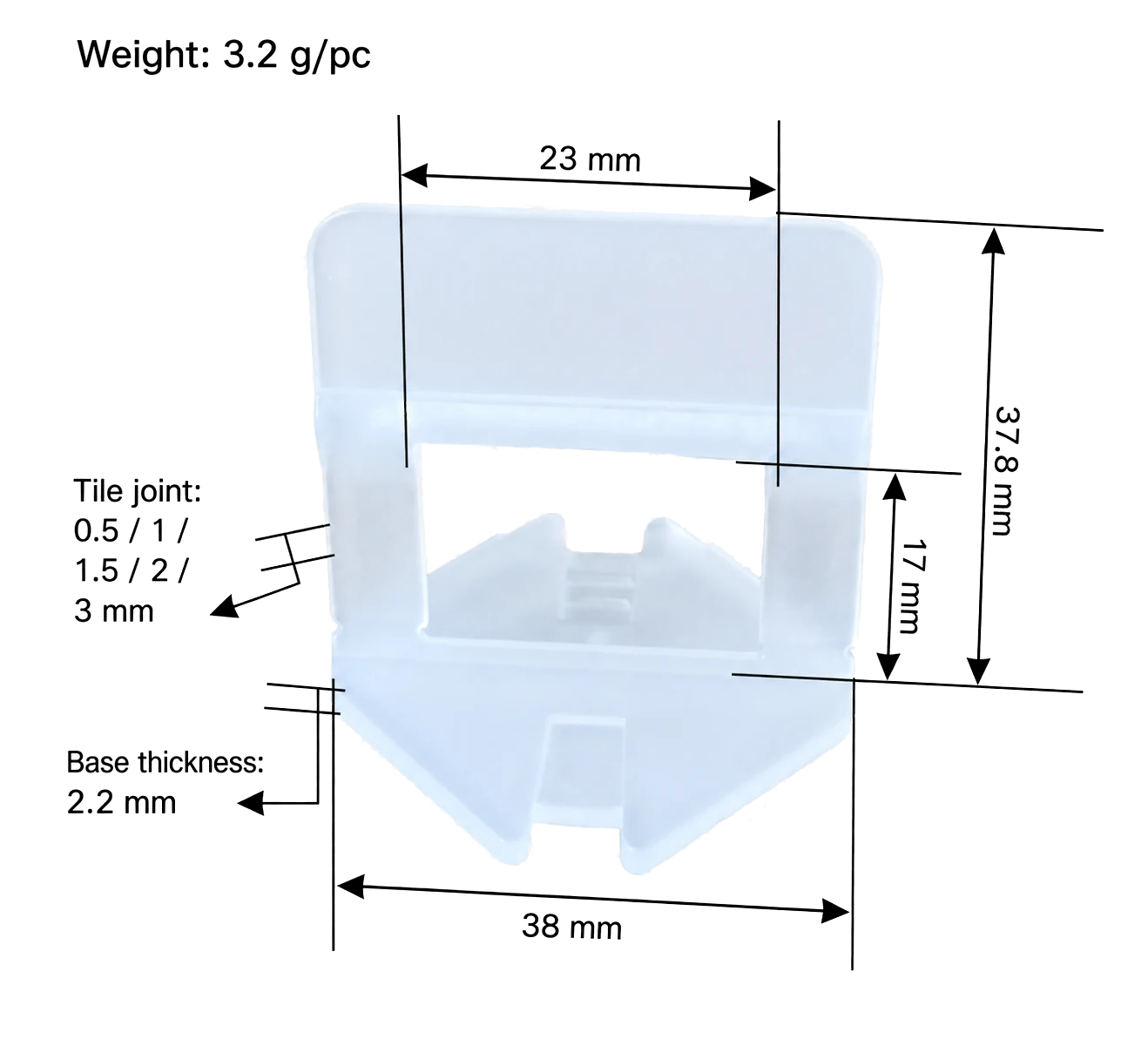
The minimum is only useful if the bag contains the right clip. The recommended tile clips cover joint widths from 0.5 mm to 3 mm and tile up to 17 mm, on a 2.2 mm base at 3.2 g. The hollow-top clips add a 2.5 mm width and reach 18 mm of tile at 2.6 g. For tile beyond that, the tall body goes to 29 mm on a 47 mm overall height.
Wedges and pliers are ordered alongside clips rather than instead of them, and the reusable wedges are sold on the same bag basis. If the joint width is still open, the joint width guide works through which gap suits which format, and the clips per square metre page converts a floor area into a bag count.
Send the joint widths you need, the tile thickness and format, and the quantity in bags. We will confirm carton data and the packing format before you commit, and quote the trade term you work on.
Related pages
- Recommended tile clips
- Reusable wedges
- Choosing between 1.0, 1.5, 2.0 and 3.0 mm joints
- How many clips do you need per square metre?
- How to use a tile leveling system
Request a quote
Ask us about this
Joint widths, tile thickness, quantity and destination port are enough for us to quote. Samples leave the factory in 3 days.